
One of the most critical decisions a Toronto homeowner faces is whether their roof needs a repair or a full replacement. Making the wrong choice can cost thousands of dollars — either by over-investing in a replacement when a repair would suffice, or by repeatedly patching a roof that has reached the end of its useful life.
In this comprehensive guide, Universal Roofs breaks down exactly how to determine whether your roof needs repair or replacement, what each option costs in the Greater Toronto Area, and how Toronto’s unique climate factors into the decision.
Understanding Roof Repair vs. Replacement: The Key Differences
Before diving into cost comparisons and decision criteria, it is important to understand what each option actually involves:
| Factor | Roof Repair | Roof Replacement |
|---|---|---|
| Scope | Fixes specific damaged areas (leaks, missing shingles, flashing failures) | Removes all existing roofing materials and installs entirely new system |
| Timeline | Hours to 1-2 days | 2-5 days depending on roof size |
| Cost Range (Toronto) | $300 – $2,500 | $8,000 – $25,000+ |
| Disruption | Minimal — often no interior work needed | Significant — debris, noise, temporary tarps |
| Warranty | Typically 1-5 years on repaired area | 25-50 year manufacturer warranty + workmanship warranty |
| Best For | Roofs under 15 years with localized damage | Roofs over 20 years or with widespread failure |
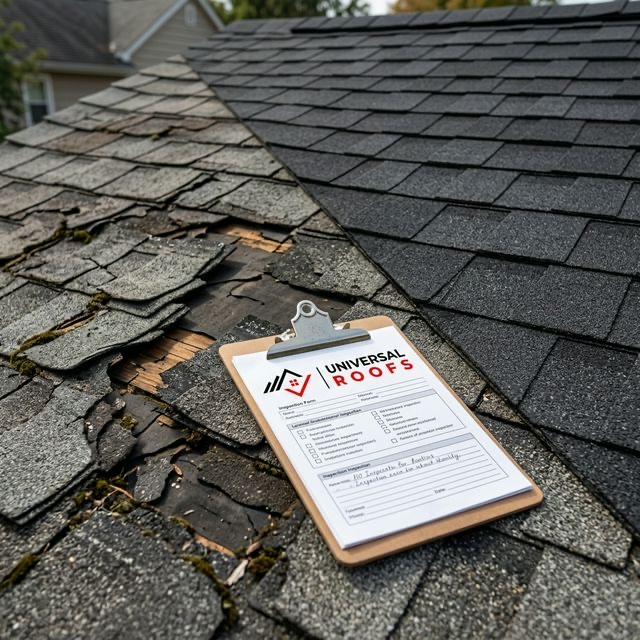
Signs Your Toronto Roof Needs Repair
Not every roofing problem requires a full replacement. Many common issues can be addressed with targeted professional roof repair. Here are the signs that indicate repair is the appropriate solution:
- Missing or Damaged Shingles in a Small Area: If you can count the affected shingles on two hands and they are confined to one section of the roof, a repair is usually sufficient. Storm damage that blows off a few shingles is a classic repair scenario.
- A Single Active Leak: One leak point that can be traced to a specific source — a cracked flashing, a failed pipe boot, or a damaged valley — is a straightforward repair. The key word is “single.” Multiple simultaneous leaks suggest systemic failure.
- Damaged Flashing Around Penetrations: Flashing around chimneys, vents, skylights, and wall junctions commonly fails before the surrounding shingles. Replacing flashing is a repair, not a replacement trigger.
- Ice Dam Damage in a Specific Area: Toronto’s freeze-thaw cycles commonly cause ice dam damage along eaves. If the rest of the roof is sound, targeted repair of the affected eave area plus improved attic ventilation is the correct approach.
- Minor Sagging Around a Vent or Skylight: Localized soft spots near penetrations often indicate water damage to a small section of decking, which can be repaired without replacing the entire roof.
Signs Your Toronto Roof Needs Full Replacement
Some conditions indicate that repair is no longer cost-effective and a full roof replacement is the smarter investment. These include:
- Age Beyond Expected Lifespan: Standard 3-tab asphalt shingles last 15 to 20 years in Toronto’s climate. Architectural shingles last 25 to 30 years. If your roof is approaching or past these milestones, replacement is inevitable regardless of current condition.
- Widespread Granule Loss: When you see significant granules accumulating in your gutters and the shingles appear bald or smooth, the protective layer is gone. UV radiation will rapidly degrade the exposed asphalt substrate, and no repair can restore granule coverage.
- Multiple Simultaneous Leaks: Two or more active leaks in different areas of the roof indicate systemic failure — the roofing membrane as a whole has degraded past its functional limit.
- Extensive Moss or Algae Growth with Underlying Damage: While surface moss can be cleaned, moss that has lifted shingle edges and allowed moisture underneath for an extended period causes irreversible damage to both shingles and decking.
- Visible Daylight Through the Roof Deck: If you can see daylight through the roof boards when standing in the attic, the decking has deteriorated to the point where only replacement can restore structural integrity.
- Sagging Roof Deck: A roof deck that sags visibly from the ground or feels spongy underfoot in the attic indicates structural failure of the decking, which requires complete removal and replacement of both decking and roofing materials.
Roof Repair and Replacement Costs in the GTA (2026)
Understanding current market pricing helps homeowners budget appropriately and evaluate contractor quotes. Here is what Toronto and GTA homeowners can expect to pay in 2026:
| Service | Average Cost (GTA 2026) | What Is Included | Typical Timeline |
|---|---|---|---|
| Emergency Leak Repair | $300 – $800 | Locate leak, temporary or permanent seal, small area repair | Same day – 1 day |
| Shingle Repair (small area) | $400 – $1,200 | Replace 10-50 shingles, reflash if needed | Half day |
| Flashing Repair/Replacement | $500 – $1,500 | Remove old flashing, install new, seal and shingle | Half day – 1 day |
| Valley Repair | $800 – $2,000 | Remove shingles along valley, replace underlayment and metal valley, reshingle | 1 day |
| Full Replacement (1,000 sq ft) | $8,000 – $12,000 | Strip, new underlayment, architectural shingles, flashing, ridge vents | 2-3 days |
| Full Replacement (1,500 sq ft) | $12,000 – $18,000 | Same as above, larger surface area | 3-4 days |
| Full Replacement (2,000+ sq ft) | $18,000 – $25,000+ | Same as above, complex roof with multiple valleys, dormers, skylights | 4-5 days |
The Impact of Toronto’s Climate on Roof Lifespan
Toronto’s climate is uniquely challenging for roofing materials. The extreme temperature range — from −25°C winter lows to +35°C summer highs — creates thermal expansion and contraction cycles that stress every component of your roofing system. Understanding these climate factors helps homeowners make informed repair vs. replacement decisions:
| Climate Factor | Effect on Roof | Impact on Repair vs. Replace Decision |
|---|---|---|
| Freeze-Thaw Cycles (100+ per winter) | Ice formation in cracks, lifting shingles, splitting flashing | Accelerates aging — reduces effective lifespan by 3-5 years vs. milder climates |
| Ice Dams | Water backup under shingles along eaves, interior leaking | Recurring ice dam damage suggests systemic ventilation/insulation issues requiring major intervention |
| Summer UV Radiation | Breaks down asphalt binders, causes granule loss and chalking | South-facing and west-facing slopes age 20-30% faster than north-facing |
| Wind Events (90+ km/h gusts) | Lifts and tears shingles, damages flashings | Wind damage to newer roof = repair; wind damage to aging roof often triggers replacement |
| Heavy Snowfall | Structural load stress, moisture exposure during melt | Homes with flat or low-slope sections need extra attention to structural capacity |
Material Options for Roof Replacement in Toronto
If replacement is the right decision, Toronto homeowners have several material options, each with different cost, longevity, and aesthetic profiles:
| Material | Cost per sq ft (installed) | Expected Lifespan (Toronto) | Best For |
|---|---|---|---|
| 3-Tab Asphalt Shingles | $4.00 – $5.50 | 15-20 years | Budget-conscious, rental properties |
| Architectural Asphalt Shingles | $5.50 – $8.00 | 25-30 years | Most Toronto homes — best value for money |
| Premium Designer Shingles | $8.00 – $12.00 | 30-40 years | High-end homes, curb appeal focused |
| Metal Roofing (Standing Seam) | $12.00 – $20.00 | 40-60 years | Longevity focused, modern aesthetics, snow shedding |
| Cedar Shake | $10.00 – $16.00 | 20-30 years | Heritage homes, natural aesthetics |
| Flat Roof (Modified Bitumen) | $6.00 – $10.00 | 15-25 years | Low-slope and flat roof sections |
The Repair-to-Replace Tipping Point: When Repairs Stop Making Sense
One of the most useful frameworks for the repair vs. replacement decision is the cumulative repair cost rule: when cumulative repair costs over the past 3 to 5 years exceed 30 to 40 percent of a full replacement cost, it is time to replace. Continuing to repair at that point is throwing good money after bad.
Here is how that plays out for a typical Toronto home:
- Full replacement cost: $15,000
- Tipping point (35%): $5,250 in cumulative repairs over 3-5 years
- If you have spent $2,000 on a leak repair last year and now face a $3,500 valley and flashing repair, you have hit $5,500 — past the tipping point. Replacement is the financially rational choice.
What to Expect During a Roof Replacement in Toronto
Understanding the replacement process helps homeowners prepare and set realistic expectations:
- Inspection and Quote: A professional assessment of your existing roof condition, measurements, and identification of any structural issues. Contact Universal Roofs for a free, no-obligation inspection.
- Material Selection: Choose your shingle style, colour, and any upgrades (premium underlayment, enhanced ventilation, new skylights).
- Preparation: The crew protects landscaping with tarps, sets up material staging, and positions dumpsters for debris removal.
- Tear-Off: All existing roofing materials are removed down to the decking. The exposed decking is inspected for rot or damage — any compromised sections are replaced.
- Installation: New ice and water shield along eaves and valleys, synthetic underlayment across the entire deck, drip edges, starter strips, field shingles, hip and ridge caps, and new flashing at all penetrations.
- Ventilation Upgrade: Modern building code requires adequate attic ventilation. New ridge vents and soffit vents are installed or upgraded as needed.
- Quality Inspection and Cleanup: Final walkthrough, all debris removed, magnetic nail sweep, and thorough cleanup of the property.
Insurance Considerations for Toronto Homeowners
Understanding how your home insurance interacts with roof repair and replacement decisions is important:
- Storm Damage: Most insurance policies cover sudden and accidental damage from wind, hail, and fallen trees. If a storm damages your roof, file a claim promptly and have a professional roofer document the damage before making temporary repairs.
- Wear and Tear: Standard home insurance does not cover gradual deterioration, aging, or maintenance-related failures. If your roof fails due to age, the replacement cost is your responsibility.
- Depreciation Penalties: Many insurers reduce claim payouts for older roofs. A 20-year-old roof claim may receive only 40 to 60 percent of replacement cost due to depreciation. This is another financial reason to replace aging roofs proactively rather than waiting for catastrophic failure.
How do I know if my roof needs repair or replacement?
The key factors are age, extent of damage, and cumulative repair costs. If your roof is under 15 years old with localized damage (a few missing shingles, one leak point, failed flashing), repair is usually the right choice. If your roof is over 20 years old, has multiple leaks, widespread granule loss, or cumulative repairs exceeding 35% of replacement cost, full replacement is the better investment.
How much does a roof replacement cost in Toronto?
A full roof replacement in Toronto costs between $8,000 and $25,000+ depending on roof size, complexity, and material choice. A typical 1,500 sq ft Toronto home with architectural shingles costs $12,000 to $18,000 including tear-off, new underlayment, shingles, flashing, ridge vents, and cleanup. Contact Universal Roofs for a free quote specific to your home.
How long does a roof last in Toronto?
Standard 3-tab asphalt shingles last 15 to 20 years in Toronto’s climate, while architectural shingles last 25 to 30 years. Metal roofing can last 40 to 60 years. Toronto’s extreme temperature swings, ice dams, and UV exposure reduce roof lifespan by 3 to 5 years compared to milder climates. Regular maintenance and adequate attic ventilation can extend these timelines.
Can I repair just part of my roof?
Yes, partial repairs are appropriate when damage is confined to a specific area and the rest of the roof is in good condition. Common partial repairs include shingle replacement in storm-damaged sections, flashing repair around chimneys or skylights, and valley repair. However, patching scattered areas of an aging roof usually indicates it is time for full replacement.
Does insurance cover roof replacement in Toronto?
Home insurance typically covers roof damage from sudden events like storms, wind, hail, and fallen trees, but does not cover gradual wear and tear or age-related failure. Storm damage claims should be filed promptly with professional documentation. Be aware that insurers apply depreciation to older roofs, potentially covering only 40 to 60 percent of replacement cost for roofs over 15 years old.
What is the best roofing material for Toronto homes?
Architectural asphalt shingles from manufacturers like CertainTeed and IKO offer the best balance of performance, appearance, and value for most Toronto homes. They provide 25 to 30 year lifespans, excellent wind resistance (up to 210 km/h), and come in a wide range of colours and styles. For homeowners seeking maximum longevity, standing seam metal roofing offers 40 to 60 year performance.
Need a professional assessment of your roof condition? Contact Universal Roofs for a free, no-obligation roof inspection. Our experienced team will provide an honest diagnosis of whether repair or replacement is the right choice for your Toronto home. Call (416) 732-2421 today.